


Waterproof or water-repellent?
These two terms come up regularly when speaking of outdoor clothing or hiking equipment, especially jackets and trousers. Different people can understand the word waterproof differently, which is why we’d like to clarify the terms.
First, a general and simplified definition:
• If a garment is made of waterproof material and all of its seams have been taped, you can call it waterproof.
• If a garment is made of waterproof material, but the seams have only been partially taped or not taped at all, we classify it as water-repellent.
• In addition, products made of a non-waterproof fabric that have been impregnated or treated with a water-repellent finish are classified as water-repellent.
What are waterproof fabrics?
A fabric’s waterproofness can be based either on a waterproof membrane laminated on the underside of the surface fabric or a surface treatment (such as the rubbery finish on traditional raincoats).
Waterproof membranes are often also breathable. This means that the moisture produced by the body can evaporate through the fabric even though liquid water cannot enter through it.
Read more about breathability.
There are differences between the various membranes and finishes, and some of them withstand water better than others. That’s why, in order to find the most suitable clothing for yourself, you should be careful when choosing an outdoor jacket or trousers.
How is waterproofness measured?
A fabric’s waterproofness can be measured with a water column test. In the test, a tube is placed tightly over a fabric, and water is entered into the tube until it begins to seep through the fabric. The height of the water column in the tube indicates how much water pressure the fabric can withstand.
The highest-quality membranes can have a water column rating of up to 28,000 mm – meaning that the measuring tube would have to be 28 metres tall to complete the test in the traditional way! Today, a device similar to a pressure washer can also be used to complete the test. The device simulates the pressure caused by a water column of a certain height.
The higher the water column rating, the better the fabric can withstand water.
What is a good enough water column rating?
In general, a water column rating of 5,000 mm means that the product can withstand normal rain showers in basic use, but if you spend longer times in heavy rain, you should acquire clothing rated between 10,000 and 20,000 mm. GORE-TEX products with a water column rating of 28,000 mm can withstand even the heaviest storms.
The rating you need also depends on how much the fabric will be pressed and stretched. For instance, if you carry a heavy backpack, sit on snow or kneel on wet ground, staying dry requires a higher water column rating because more pressure will be put on the fabric.
Choosing a suitable water column rating
This table will give you an idea of the ratings suitable for different uses.
| Water column | Conditions |
| 3,000 mm | Light rainfall, dry snow, no pressure. |
| 5,000 mm | Light rainfall, snowfall, light pressure. |
| 10,000 mm | Normal rainfall, snowfall, medium pressure. |
| 15,000 mm | Heavy rainfall, wet snow, high pressure. |
| 20,000 mm and above | Heavy rainfall, wet snow, very high pressure. |
Takkeja, joiden vesipilariarvo on vähintään 10 000 mm
What does taped seams mean?
Taping means that a tape-like narrow strip is glued on the inside seams of a garment to prevent water from seeping through the stitches. Only when all the seams have been taped can the product be said to be waterproof.
Sometimes taping can also be referred to as welding if the tape is glued on the seam using heat and pressure. In some products, such as certain raincoats, the parts can really be “welded” directly to each other without any stitching.
In other products, only the most critical seams in terms of protection (e.g. hoods and shoulders) have been taped. In most situations, these products keep you as dry as garments with all seams taped would, but they aren’t entirely waterproof.
If the product doesn’t have taped seams, it is always merely water-repellent, not waterproof, even if the fabric itself is waterproof. The most common example is softshell products.
What is a water-repellent finish? Is it the same as DWR?
Many fabrics can be treated with a water-repellent treatment or impregnated, which prevents the threads from absorbing water. A similar treatment is called a DWR (durable water repellent) treatment, and it practically means the same thing.
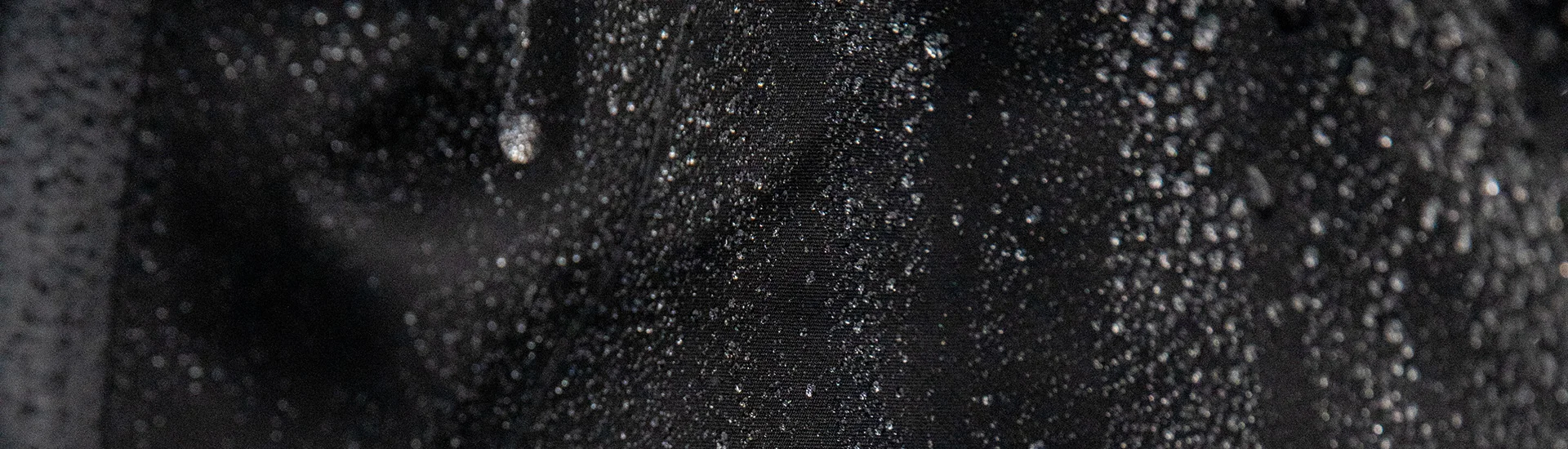
Thanks to the surface treatment, small amounts of water will remain as beads on the fabric’s surface, but the treatment doesn’t completely prevent water from passing through the fabric. You’ll stay comfortably dry in light rain for a short period of time, but if it’s pouring or you’ll be outside for a long time, a surface treatment isn’t enough.
Products with a waterproof membrane are usually treated with a water-repellent finish as well. Without the treatment, the surface fabric would absorb so much water it would make the garment heavy and less breathable.
My clothes aren’t as water-repellent as before. What can I do?
A water-repellent finish will wear out when the garment is used and washed, and it won't last forever. After washing, the water-repellent finish may require reactivation with heat, for instance, by drying the garment in a tumble dryer or ironing at low heat. Remember to follow the garment’s washing instructions so you don’t damage it.
If reactivation doesn't work anymore, you can renew the surface treatment either at a laundry service or at home using widely available surface treatment or impregnation substances. Always follow instructions carefully and make sure that the treatment is suitable for your garment.