


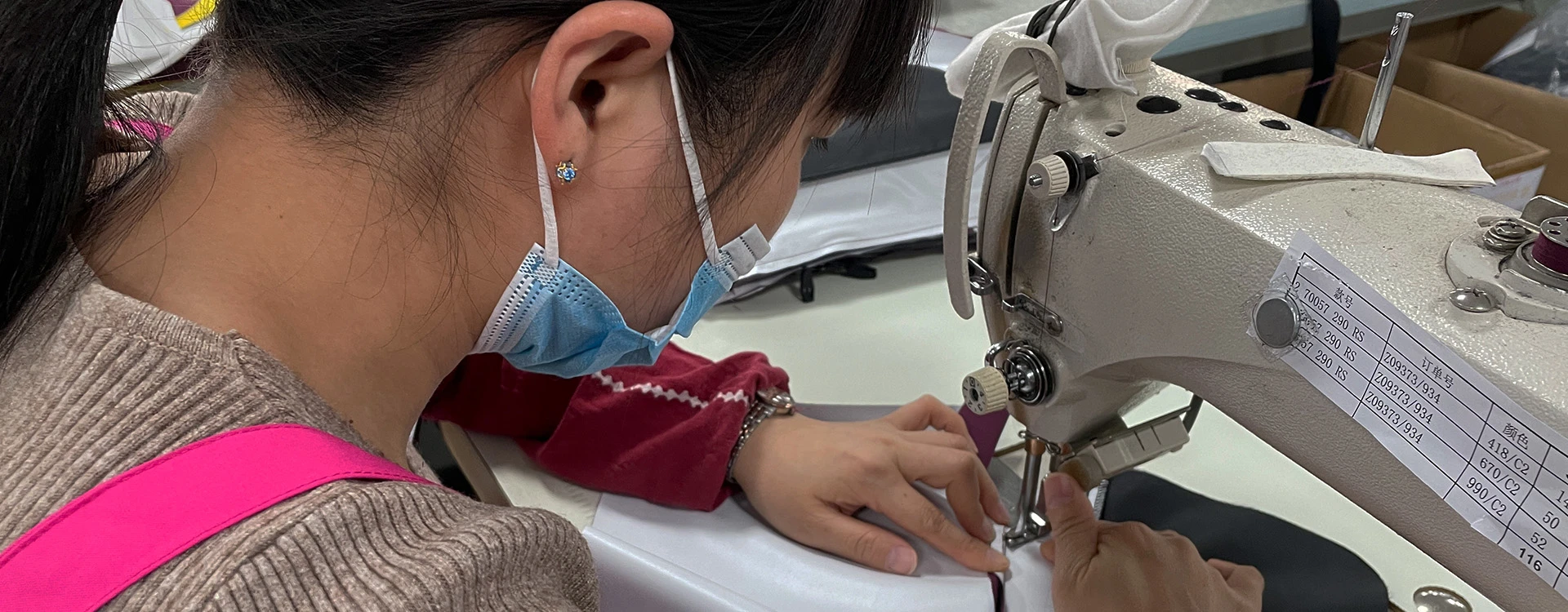
Production
The most significant environmental- and human-related sustainability impacts in our industry arise from long and global value chains. We recognize the challenge of supply chain management, and one of the key developments in our sustainability work is to identify the environmental, human and economic impacts of our value chain and to work purposefully to minimize the adverse sustainability impacts and promote the positive ones in our supply chain.
Production chain management at Luhta
We seek to ensure and promote social and environmental responsibility in our supply chain through a range of policies and procedures, processes and measures. Our production team in Finland manages, coordinates and guides the overall production and sourcing process. In Suzhou, China, operations are implemented by Luhta’s own organization, which became operational in 2002. The organization is responsible for communicating with suppliers, providing guidance to suppliers, testing and monitoring the operational quality of suppliers, and monitoring sustainability. In addition to production quality, it is also responsible for ensuring that the reality in the factories corresponds to what is agreed in our Supplier and Partner Code of Conduct. Our own organization carefully selects the factories and visits them, both at the beginning of production and during the season.
Luhta’s procurements are made in compliance with responsible sourcing principles, and our suppliers must commit to Luhta’s Supplier Code of Conduct and the following policies Amfori BSCI Code of Conduct, Luhta Human Rights Commitment, Luhta Child Labour, Luhta Labour Rights Policy, Restricted Substance List (RSL), Luhta Environmental Policy and Luhta Animal Welfare Policy.
Compliance with the principles is monitored by both Luhta’s internal and external auditors. Whenever we select new suppliers, we engage in dialogue with them to verify their certifications, practices, social and environmental responsibility, etc. We also require all our partners to provide information about all subcontractors and any audit reports that may be available. Where appropriate, we may prohibit a partner from using a particular subcontractor if, for example, there is a high risk of human rights violations.
We publish an annually updated list of our contract manufacturers to increase transparency about who manufactures our products and where.
North Star process and third-party audits to ensure supply chain responsibility
More than 90% of all our products are manufactured outside the EU – in China, where we have long and close working relationships with our contract manufacturers. Transparency throughout the supply chain and ensuring product quality is important to us. For this, we have North Star, our own internal supply chain management process. The North Star process is designed to increase supply chain transparency currently in China together with our amfori BSCI membership. Through our long and close partnerships and the North Star process, we aim to ensure product quality and good transparency in our value chain. Through these processes, we monitor our production in terms of both product quality and from the perspective of social and environmental responsibility of the production.
North Star helps us to regularly monitor suppliers and manufacturers and to carry out quality audits before and during production. In addition to quality control, audits are performed to ensure compliance with our requirements. In 2024, under our North Star process, we made 4,440 visits (including supplier visits during the product development phase) to our partners across all our product categories. Through the North Star process, we conducted a total of 211 factory audits in 2024. Some of the audit visits are unannounced, i.e. the supplier is not informed in advance of these audit visits. In addition to ensuring that conditions comply with the applicable requirements, these audits also ensure that our products are manufactured in the factories that have been reported to us. North Star also acts as a robust internal audit to verify processes and confirm the origin of the materials we use.
In addition to our North Star process, when assessing working conditions and the implementation of human rights at factories located in risk countries, we use international social responsibility auditing and certification systems, primarily amfori BSCI auditing. We examine the results of amfori BSCI audits as part of our supply chain sustainability management and development. We also accept other social responsibility assessment systems if their criteria are equivalent to those of amfori BSCI auditing and the auditing has been carried out by an independent party (e.g. SA8000).
Read more about our supply chain-related sustainability work in our Sustainability Review.
Living Wages in our Value Chain
We have assessed the human rights impacts and risks of our business across our entire value chain. Based on a human rights-based risk assessment conducted in 2024, living wages are one of the key human rights issues in our supply chain.
In global and long value chains, low wage levels and wages that are insufficient to live on are a major recognized problem. Poverty is recognized as the root cause of many global social challenges and environmental problems. Paying workers a living wage is a key measure of reducing poverty. At the same time, it strengthens the sustainability and productivity of supply chains and the workforce.
Commitment to promoting a living wage
We are committed to ensuring gender pay equality and a living wage for all our employees. We assess the situation annually and make any necessary adjustments. At our subsidiary in Suzhou, we have been conducting a salary monitoring process since 2021 to ensure that the salaries we pay exceed the local living wage level defined by the Global Living Wage Coalition. If the annual review shows that the salary level falls below the defined level, we will take corrective measures in cooperation with local management.
We are committed to fair remuneration and living wages. We are committed to working to ensure that all employees throughout our supply and production chain are paid at least a living wage. This commitment covers both our own operations and our supplier network.
We are currently working to ensure that our supplier network pays at least the legal minimum wage through our policies and audit practices. However, we are aware that the legal minimum wage often does not correspond to a living wage. We are actively exploring solutions to achieve this goal in collaboration with other industry players and stakeholders.
What does a living wage mean?
A living wage is a different concept from the minimum wage defined by law. In its human rights work, Luhta Sportswear Company defines a living wage in accordance with the Anker methodology recognized by the international Global Living Wage Coalition. A living wage is defined as the minimum wage that an employee needs to cover their family's reasonable standard of living and basic needs, including food, water, housing, education, healthcare, transportation, energy, clothing, and other essential needs, as well as provisions for unexpected expenses. A living wage does not include compensation for overtime and must be earned from normal working hours (the ILO Working Time Convention sets the maximum normal working hours at 48 hours per week).
How do we promote living wages in our value chain?
We want to promote living wages throughout our value chain, and in 2024 we began working on a roadmap to ensure that all employees in our supply chain receive a living wage. We are promoting this work in a systematic manner in cooperation with various stakeholders and our suppliers.
We have defined the following key measures as part of our development work:
• In 2021: We conducted wage level reviews at our Suzhou subsidiary to ensure that the wages we pay exceed the local living wage level defined by the Global Living Wage Coalition. We will continue to conduct wage level reviews annually. If the annual review shows that the wage level falls below the defined level, we will take corrective measures in cooperation with local management.
• In 2023: We updated our human rights policies, and the Board of Directors approved a human rights commitment.
• In 2024: We conducted a human rights risk assessment and, as part of the risk assessment, we identified living wages as a key and prioritized human rights issue. We developed a due diligence process development plan, in which we identified the countries and suppliers we will focus on based on the human rights risk assessment.
• In 2024: We began mapping information on living wage levels and the current state of wages in our supply chain.
• During 2024–2025: We will increase our internal expertise on the subject and train our procurement and production organizations on the implementation of human rights and living wages.
• By 2025: We will implement a development plan to promote living wages in our value chain.
• By 2025: We will identify living wage levels in all our key production countries and continue to systematically collect wage data from our supply chain based on current wages.
• By 2025: We will develop our responsible purchasing practices to support suppliers in paying fair wages, particularly in terms of pricing and delivery times.
• By 2026: We will incorporate living wages into our North Star process and systematically include the topic in supplier monitoring, assessment, and dialogue throughout our production network.
• By 2026: We will collaborate with multi-stakeholder initiatives, other companies, and local actors to promote structural change.